Corridor and staircase lighting
Corridors and staircases are where light is wasted most. People only pass through, yet the old luminaires burn all day or all night. At the same time, it is on the stairs that good light decides whether someone trips.
For building managers, owners’ associations and companies we design and supply LED sensor luminaires for corridors, staircases, entrances and communal areas – with a motion sensor, corridor function and, where needed, an emergency module.
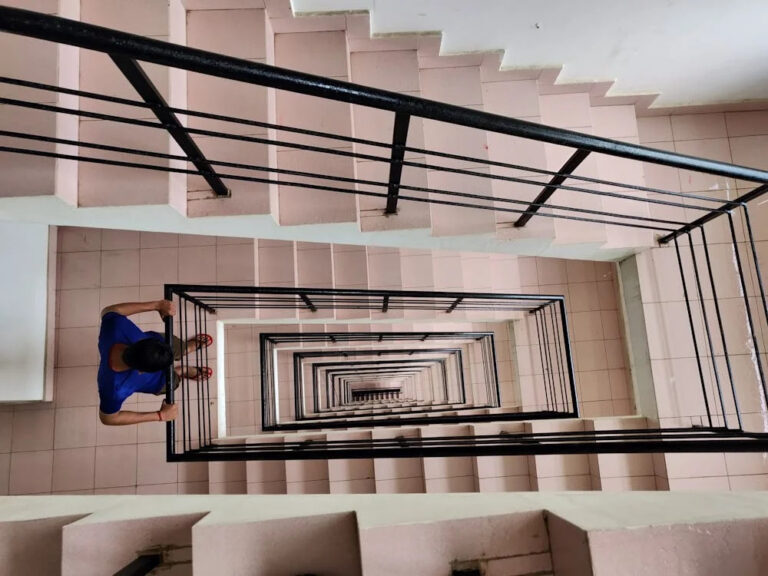
lower luminaire wattage on the staircase and corridors of a residential building in Trenčín – 12 W LED with a sensor instead of 36 W fluorescents
SENZO sensor luminaires in a single residential building in Bratislava
residential buildings and communal areas with LED sensor lighting
warranty on the SID, LIVIA ECO, SUZAN and SANTOS ECO luminaires
What corridor and staircase lighting has to do
Nobody reads or works in a corridor or on a staircase, but everyone passes through – children, older residents, neighbours carrying the shopping. The light therefore has to come on instantly, be even and free of glare, and it must not burn when nobody is there.
Safe stairs
Stairs have to be clearly readable – a well-defined nosing on every step, no dark patches on the landing and luminaires that do not dazzle when you look up or down.
Light only when someone is there
The motion sensor switches the luminaire on when someone arrives and off again after a set time. Nobody has to hunt for a switch and nothing burns needlessly.
Emergency lighting
If the power fails, the escape route has to stay lit. The SID, SANDRA and LIVIA ECO sensor luminaires are also available with a 3-hour emergency module.
Maintenance-free
A luminaire with an integrated LED source never has to be opened to change a lamp or a starter. A service life of 40,000 to 100,000 hours lasts for years in communal areas.
How much light corridors and staircases need
EN 12464-1 sets the maintained illuminance, uniformity and glare limit for circulation areas inside buildings. The requirement for staircases is higher than for corridors, so that the steps can be made out. Emergency lighting of escape routes is covered by a separate standard, EN 1838.
The values are indicative. We determine the type, number and layout of the luminaires for your building in a lighting calculation.
| ILLUMINANCE | AREA |
|---|---|
| 1 lx | emergency lighting of an escape route during a power failure (EN 1838) |
| 100 lx | corridors and circulation areas, lifts – UGR ≤ 28, uniformity 0.4 |
| 100 – 150 lx | staircases – UGR ≤ 25, uniformity 0.4; for heavy use we recommend 150 lx |
| 200 lx | entrance halls and reception areas |
Which luminaire for a corridor or staircase
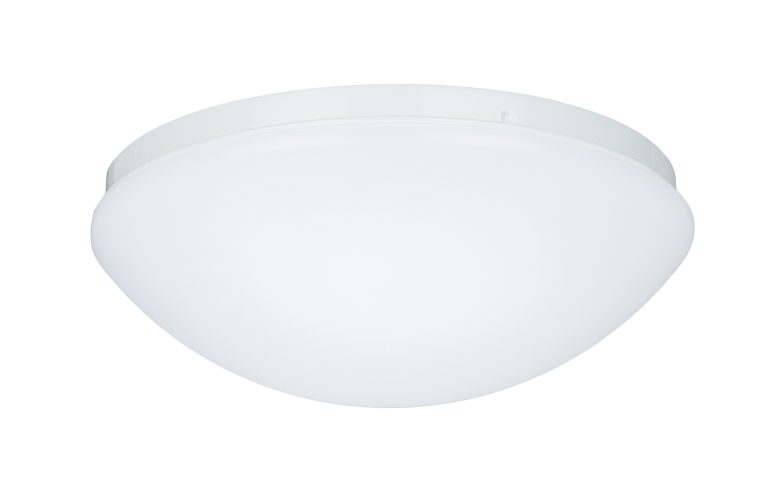
In residential buildings, surface-mounted ceiling and wall luminaires with a built-in sensor have proved themselves best. Where emergency lighting is required, we add a module inside the luminaire itself or separate emergency luminaires.
Residential buildings
Sensor luminaires
SANDRA from 12 to 40 W with a microwave sensor and corridor function, SENZO from 9 to 15 W, SID 16 and 22 W with an emergency module in the same luminaire, and SENZO II with an IP 65 rating for outdoor entrances too.

Companies and public buildings
Ceiling luminaires
LIVIA ECO with an efficacy of up to 125 lm/W and a service life of 100,000 hours, SUZAN with an IP 65 rating and SANTOS ECO with IK 10 – tough enough for school and council building corridors. Sensor and emergency module to order, and DALI on the SANTOS ECO.


Sensors and the corridor function: never in the dark, never on for nothing
With the corridor function the luminaire never goes out completely; it drops to a reduced level, say 20%. When the sensor picks up movement, it comes up to full output. Anyone stepping into the corridor is never left in the dark – and the building pays for only a fraction of the light. In rarely used corridors the luminaire can switch off altogether after a set time.
- microwave sensor – covers a larger area and works even when hidden behind the diffuser
- PIR sensor – responds to heat, suited to smaller spaces
- adjustable on-time from seconds to tens of minutes
- daylight threshold – no light during the day near windows
- emergency module with 3 hours of autonomy
- DALI for connection to the building management system
Case study
Staircase and corridors of a residential building in Trenčín
In a residential building on Východná street in the Juh estate in Trenčín, managed by ERES, the staircase and corridors were lit by 36 W fluorescent luminaires. We replaced them with LED sensor luminaires with a microwave sensor and a power input of 12 W. Each luminaire therefore draws two thirds less power, and on top of that it only lights up when somebody is moving about the building.
Before
- 36 W fluorescents
- lighting with no sensor
- replacing tubes and starters
Solution
- 12 W LED luminaires
- microwave motion sensor
- integrated LED source, nothing to replace
power input per luminaire
lower power input, before the savings from the sensor
light only when there is movement
year of installation
How we work
Site survey
We walk the building – the number of floors, luminaires and switches, and the spots that are dark or lit for no reason.
Design
The luminaire type, the sensor, the on-time and emergency lighting wherever the building needs it.
Quotation with the savings
The price, energy consumption before and after the replacement and the payback – ready for the owners’ meeting.
Installation
Luminaire-for-luminaire replacement on the existing outlets, with no chasing and without disrupting the building.
Warranty and service
A warranty of up to 5 years depending on the luminaire type, and spare parts available years later.
More buildings and communal areas
All projects →FAQ
What building managers, owners’ associations and companies ask us.
How much does a sensor luminaire save compared with a conventional one?
Twice over. First on power input – in the residential building in Trenčín a 12 W LED luminaire replaced a 36 W fluorescent one. Then on running hours – a luminaire with a sensor only lights up when somebody is moving along the corridor, or, with the corridor function, runs at reduced output the rest of the time.
What is the difference between a microwave and a PIR sensor?
A microwave sensor picks up movement over a larger area, passes through thin non-metallic materials and can be hidden behind the luminaire’s diffuser. A PIR sensor responds to the heat of the human body and needs a direct “view” of the person – it suits smaller spaces. For staircases in residential buildings we usually recommend a microwave sensor.
What is the corridor function?
Once the person has gone, the luminaire does not switch off completely but drops its output, to 20% for example. At the next movement it comes back up to full. The corridor is never in total darkness and energy consumption stays low.
Does a residential building need emergency lighting?
That depends on the building’s design documentation and its fire safety strategy. If the building does require it, we supply sensor luminaires with a 3-hour emergency module or separate emergency luminaires for the escape routes. When luminaires are being replaced, we recommend checking the requirements in the design documentation.
Can a luminaire be replaced without breaking into the walls?
Yes. The new luminaire connects to the existing outlet and the sensor sits inside it, so there is no need to run new cabling or change the switches. The replacement is carried out floor by floor while the building stays in use.
How is the on-time set?
The on-time, the sensor sensitivity and the daylight threshold are all set on the luminaire. We set them during installation to match how quickly people move about the building – longer on the staircase, shorter in a short corridor.
From our blog
All articles →Related solutions