Lighting for schools and kindergartens
Children spend most of the day in the classroom, learning under light they never chose. Good school lighting does not dazzle, renders colours faithfully and does not flicker – and once the old fluorescent tubes are gone, it usually costs the operator far less in energy.
For schools, kindergartens, local authorities and construction firms we design and supply lighting for the whole building – panels and linear luminaires for classrooms, sensor luminaires for corridors and cloakrooms, luminaires for the sports hall, emergency lighting and acoustic luminaires for noisy spaces.
required by the standard in a classroom – and 500 lx on the whiteboard, which therefore needs a luminaire of its own
glare of the PRIUS PRO panels and LOTA GP luminaires – the value the standard requires in a classroom
designed in a DIALux calculation – Trenčianska Turná primary school and the village of Ludanice
extended warranty on PRIUS PRO, LOTA GP, PERUN L and LIVIA ECO
What school lighting has to do
In a school it is not just about being able to see. Children concentrate, read, draw and look at the whiteboard under this light – and in a kindergarten they play on the floor and look up at the ceiling. The lighting has to be comfortable for the eyes all day long, not merely bright enough.
Low glare
In a classroom the standard requires UGR ≤ 19. Panels and linear luminaires with a micro-prismatic or parabolic cover do not shine into the eyes, not even for the children sitting directly beneath them.
True colours
A colour rendering index of Ra ≥ 80 makes sure that the colours in a textbook, in a picture or in a piece of artwork look the way they should. For art rooms, Ra 90 is the better choice.
Uniformity
Light with no dark patches and no harsh contrasts. A classroom calls for uniformity of Uo ≥ 0.60 and ≥ 0.70 on the whiteboard – which is why the whiteboard is lit separately.
Running costs and savings
T5 and T8 fluorescent tubes are no longer made in the EU. Switching to LED cuts energy consumption and the number of maintenance call-outs alike – and the luminaires run for years without attention.
How much light a classroom needs
The requirements for schools and kindergartens are set out in EN 12464-1. Alongside illuminance it also prescribes the level of glare (UGR), uniformity (Uo) and colour rendering (Ra) – and it is these that decide whether a classroom feels pleasant.
The whiteboard is a visual task area in its own right. If it is lit only by a ceiling luminaire in the middle of the room, the values on it will fall short and children at the back desks will see the board less clearly than their own exercise book.
The values are indicative. We will determine the exact solution for your school in a lighting calculation.
| ILLUMINANCE | SPACE |
|---|---|
| 100 lx | corridors |
| 150 lx | staircases |
| 200 lx | entrance hall, cloakrooms, dining hall |
| 300 lx | classrooms, kindergarten playrooms, computer rooms, preparation rooms and the staff room |
| 300 lx | sports hall for school PE (UGR ≤ 22) |
| 500 lx | whiteboard, art and craft work, reading room, lecture room |
Which luminaires for a school or kindergarten
Every space in the building has a different job to do. Classrooms need low-glare luminaires, corridors and cloakrooms sensor luminaires, the sports hall robust ones, and kindergarten suspended ceilings slim panels.
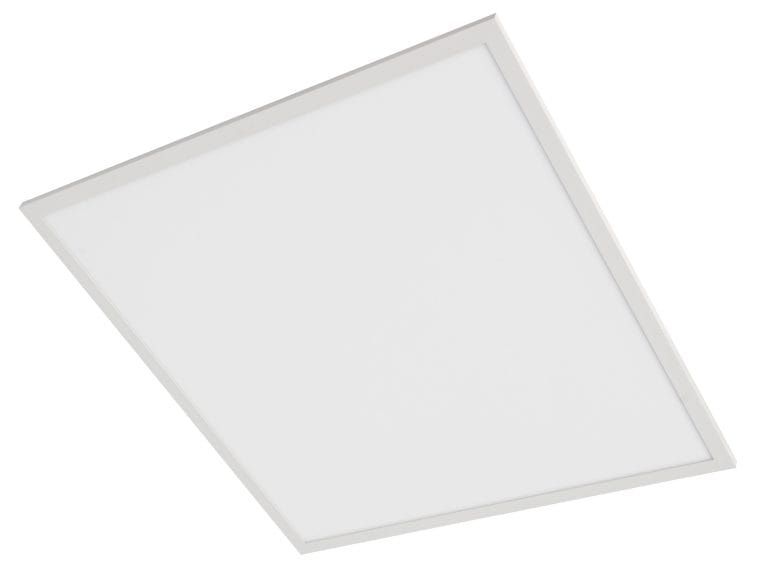
Classrooms and staff room
Panels and linear luminaires
PRIUS PRO with UGR < 19 and adjustable power input from 18 to 28 W for modular ceilings, and LOTA GP with a twin parabolic reflector and both direct and indirect light where there is no suspended ceiling.

Playrooms, dining hall and servery
Linear luminaires
LIVIA and LENA ECO+ with an efficacy of up to 185 lm/W, Ra above 80 and an IP 66 rating for playrooms, the dining hall and the servery. The polycarbonate body stands up to stray balls and rough handling.
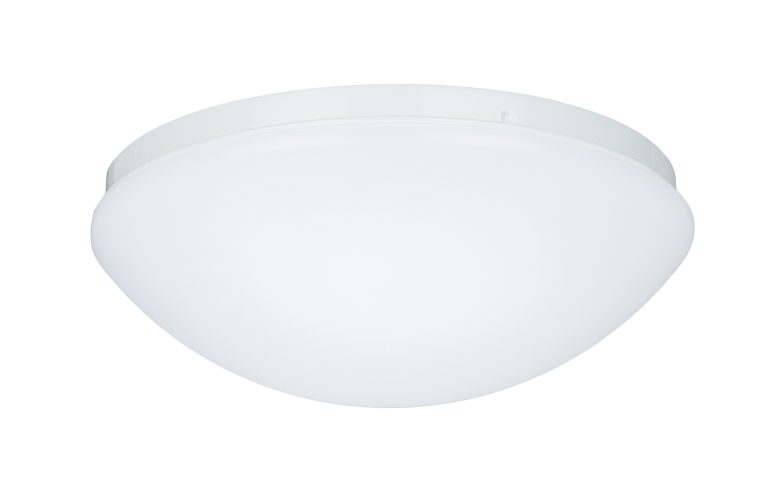
Corridors, cloakrooms and toilets
Sensor luminaires
SANDRA and LIVIA ECO with a microwave motion sensor come on only when someone walks past. In corridors and cloakrooms, where the light is often left on all day, this is the quickest saving of all.

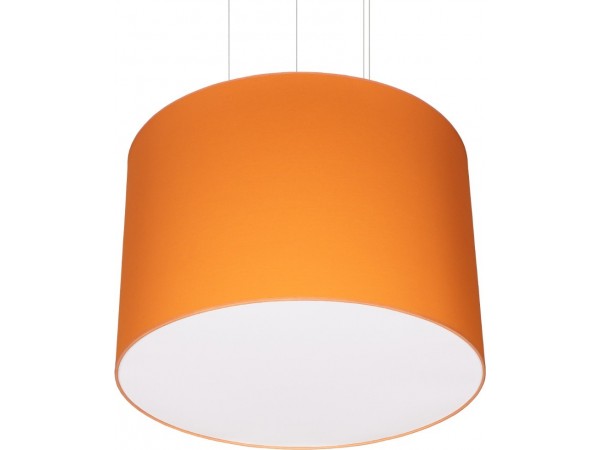
Noise in the dining hall and the corridor: a luminaire that also absorbs it
A school dining hall, corridor or playroom with hard surfaces reflects sound, and the noise multiplies. The SANTOS A acoustic luminaire has a fabric-clad body that damps those reflections – while lighting the space just as well as an ordinary pendant luminaire.
- five diameters from 300 to 1,000 mm
- three body heights – 150, 250 and 400 mm; a taller body absorbs more sound
- efficacy of up to 103 lm/W and a service life of 50,000 hours
- optional DALI, Bluetooth control or a motion sensor
- KLARA acoustic panels with no light source where more absorption is needed
- silver-grey and green felt, further shades to order
Controls: light that follows the timetable, not habit
A lot of light in a school burns for nothing – in the corridor during lessons, in the sports hall over break, in the classroom by the window on a sunny day. Sensors and dimming take care of it without anyone having to think about the switch.
- motion sensors in corridors, cloakrooms and toilets
- corridor function on PERUN L – the luminaire fades up smoothly and fades down just as smoothly
- DALI dimming in classrooms according to the daylight contribution
- neutral white 4,000 K for classrooms, warmer light for kindergarten playrooms
- we can supply the design and programming of the controls as a separate service
Emergency lighting and escape routes
A school is a building with a high concentration of people who do not find their bearings as quickly as adults do. Emergency lighting in corridors and on staircases is therefore a given – and you have to be able to prove that it works.
- ZARA luminaires for escape routes and anti-panic lighting of open areas
- ZERO II with an IP 66 rating for the sports hall and plant rooms
- 1 or 3 hours of autonomous operation after a power failure
- self-test button, autonomous test system or central monitoring
- option of connection to a central battery
- emergency lighting module built directly into the LOTA GP, PERUN L, LIVIA ECO and SANDRA luminaires
Case study
Sports hall, Trenčianska Turná primary school
The primary school sports hall is lit by 20 LENA ECO+ LED linear luminaires, 150 cm long, with a power input of 106 W and a colour temperature of 5,000 K.
We designed the luminaire layout in DIALux so that the required lighting uniformity would be achieved – in a sports hall that matters more than illuminance itself, because the ball and the players move across the whole floor.
Brief
- primary school sports hall
- uniformity across the whole floor
- ball resistance
Solution
- 20 × LENA ECO+ 150 cm
- 106 W, 5,000 K
- designed in DIALux

LENA ECO+ 150 cm
luminaire power input
daylight white
verified uniformity
How we work
Site survey
We walk the classrooms, corridors, sports hall and preparation rooms. We record what is lighting them today and how many watts it draws.
DIALux calculation
Illuminance, uniformity and glare for every type of room – including separate light on the whiteboard.
Quotation with savings
Luminaires for the whole building, energy consumption before and after, payback. Documentation that will stand up in front of a council meeting.
Installation
Most often during the holidays, or in stages so that teaching never has to stop.
Warranty and service
Extended 5-year warranty on PRIUS PRO, LOTA GP, PERUN L and LIVIA ECO.
More projects
All projects →FAQ
What head teachers, local authorities and construction firms ask us.
How much light should there be in a classroom?
EN 12464-1 requires a maintained illuminance of 300 lx in a classroom, with glare of UGR ≤ 19, uniformity of Uo ≥ 0.60 and colour rendering of Ra ≥ 80. On the whiteboard it is 500 lx and uniformity of ≥ 0.70, which is why the whiteboard needs a luminaire of its own.
Which colour of light should I choose for a school, and which for a kindergarten?
For classrooms the usual choice is neutral white 4,000 K – it looks natural without feeling cold. In nursery playrooms, where children play on the floor and look up at the ceiling, warmer light tends to be more pleasant. The standard does not prescribe a colour of light; it is a matter of design.
Can the lighting be replaced during the school year?
Yes, though it goes most smoothly during the holidays. If waiting is not an option, we work in stages – corridors and common areas first, then classrooms floor by floor, so that teaching can carry on.
What should we do about T5 and T8 fluorescent tubes no longer being made?
The EU ban on placing them on the market means that one day the old tubes simply cannot be bought any more. Rather than topping up tubes as they fail, it pays to replace the luminaires outright – the LOTA GP, LIVIA and LENA ECO+ linear LED luminaires are direct replacements for T5 and T8 fluorescent tubes.
What difference will the replacement make to energy bills?
It depends on what is lighting the building today and for how long. The biggest effect usually comes from combining more efficient luminaires with sensors in corridors and cloakrooms, where the light is often left burning for nothing. You will get a specific calculation of consumption before and after in the quotation.
Do you carry out lighting calculations?
Yes, we design the layout in DIALux and hand over a report with illuminance, uniformity and glare values for every room. Both sports halls – in Trenčianska Turná and in Ludanice – were designed this way.
From our blog
All articles →Related solutions