When choosing luminaires for business premises, besides the power (W), colour temperature (K), luminous flux (lm), service life (h) and IP rating, you should also look at another important parameter – luminaire efficacy. It is often overlooked, even though it carries really important information. If you have never heard of it, or have heard something but are not sure what exactly it expresses, read our article!
What does luminaire efficacy express?
Luminaire efficacy is one of the key parameters you should definitely know when modernising the lighting of business premises (reception, offices, company site, warehouses, halls…). Why?
The textbook definition says that efficacy expresses the amount of light produced per unit of energy consumed. In plain language, it shows how efficiently a luminaire converts electricity into light – in other words, how economical the luminaire is.

You can see it in the formula:
LUMINAIRE EFFICACY = LUMINOUS FLUX (lm)/POWER (W)
Power tells us how much energy the luminaire consumes (takes in), and luminous flux tells us how much light it can produce (gives out). Efficacy then expresses how efficiently the luminaire converts the energy it takes in into the light it produces. Simple, isn’t it?
👉 EXAMPLE:
If a luminaire has an efficacy of 100 lm/W, it converts every watt it takes in into 100 lumens. As we will show later in this article, the higher the number, the better – a luminaire with high efficacy is doing its job really well.
Light source efficacy ≠ luminaire efficacy
Do not confuse these two quantities, though – they are different things.
- Light source efficacy tells us how well the light source itself – a bulb, fluorescent tube, discharge lamp or LED chip – converts electricity into luminous flux.

- By contrast, luminaire efficacy tells us how well the whole luminaire converts electricity into usable luminous flux. Besides the light source, a luminaire contains other components (diffusers, optics) that affect how the light is distributed.
Did you know…?
Luminaire efficacy depends not only on the light source itself, but also on the quality of the optical systems, heat losses and the overall design of the luminaire. Two luminaires with the same light source can have different efficacies – the one with better optics and lower energy losses can be more efficient.

You can probably guess which figure tells you more – yes, it is the efficacy of the luminaire, not of the light source alone. Luminaire efficacy already includes all losses (optical and electrical), so it gives you a better picture of how efficiently the whole luminaire converts energy into light.
Why is it worth knowing luminaire efficacy?
Different types of luminaires have different efficacies. As mentioned above, the higher the luminaire efficacy, the better (the luminaire converts energy into light more efficiently and is more economical).
What does higher luminaire efficacy bring you?
- Greater savings: Luminaires with higher efficacy use less electricity to produce the same amount of light. That means lower electricity costs.
- Environmental benefit: Less energy consumed means fewer emissions. More efficient luminaires help not only you but also our planet.
- Longer service life: Luminaires with higher efficacy often use more advanced technologies that are more durable and reliable.

LED luminaires vs. older lighting technologies
Lighting technology keeps moving forward. Today’s market is dominated by LED luminaires with an efficacy of roughly 100–200 lm/W. We consider them the lighting standard, mainly thanks to their high efficiency, long service life, versatility and low operating costs.
In an effort to reduce energy consumption and improve environmental sustainability, many countries have gradually introduced regulations that restrict or completely ban the manufacture and sale of less efficient light sources.
Older lighting technologies have effectively had their day. Classic incandescent bulbs, halogen lamps, compact fluorescent lamps, linear fluorescent tubes and sodium lamps are gradually being pushed off the market by more efficient LED technology. Although the sale of some of them is not yet completely banned, their use is gradually being restricted. Technological progress and the need to consider environmental impacts are putting pressure on phasing out older technologies.

Image source: www.pixabay.com
Are you wondering what the efficacy is of the predecessors of LED luminaires that are still in service in some places (despite being highly inefficient)?
1. Tungsten filament bulbs
Classic bulbs are the least efficient solution. Their efficacy is very low, usually only around 10–15 lm/W.
Did you know…?
In the “good old” bulbs, up to 90 % of the energy turns into heat and only 10 % into light – so they were great for heating, but less so for lighting.
2. Halogen bulbs
Halogen lamps offered slightly better performance and a longer life than classic bulbs – but their efficacy is only 15–25 lm/W.
3. Compact fluorescent lamps (CFL)
Compact fluorescent lamps have an efficacy of roughly 40–70 lm/W.
4. Linear fluorescent tubes
The efficacy of linear fluorescent tubes is approximately 100 lm/W.
5. High-pressure sodium lamps
They used to be popular because of their high efficiency, so you could see them in many places (streets, motorways, industrial sites…). Compared with LEDs, they have a shorter life, a narrower colour spectrum and poorer colour rendering (lower CRI). Their efficacy ranges from 80 to 120 lm/W.
6. Low-pressure sodium lamps
These are efficient light sources with an efficacy of up to 100–200 lm/W, but their distinctly yellow light limits their use. This monochromatic light in the yellow-orange spectrum has a very low colour rendering index. Even so, you can still see this technology in street and road lighting.
7. LED luminaires
LED technology is currently one of the most efficient, with an efficacy of 100–200 lm/W. It is a versatile solution that offers high lighting quality and a long service life. This makes it suitable for most modern applications where not only efficiency matters, but also lighting quality and environmental friendliness.
Our range includes the high-efficiency PRIMUS luminaire with an efficacy of up to 197 lm/W. Compared with a conventional discharge lamp, a single PRIMUS can save you up to €374 a year.
Energy and cost savings from a high-efficiency luminaire can be really significant, especially across an entire lighting installation.
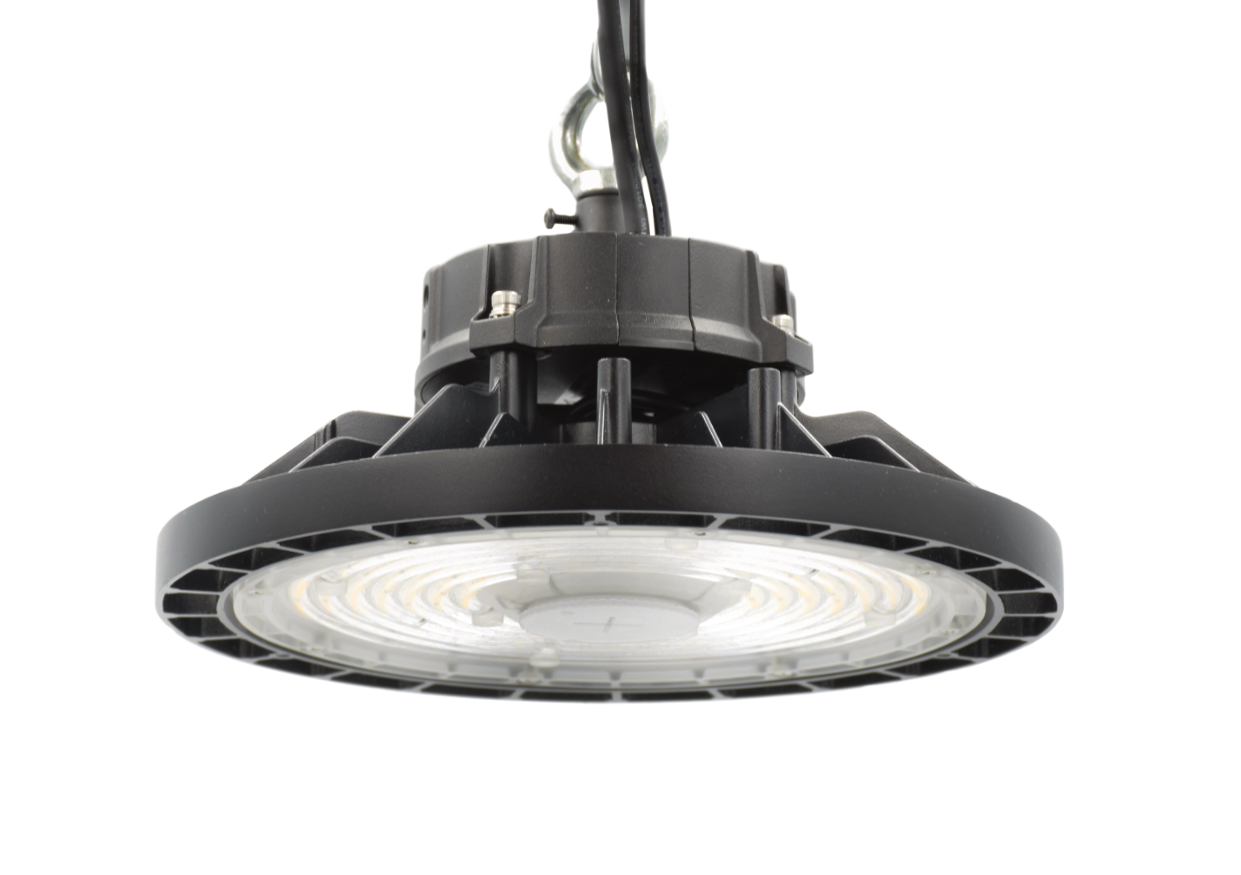

Note that there can be huge differences even within one technology (LED included), and the efficacy of individual luminaires can vary considerably.
Trends in lighting technology
So what are the current trends in efficacy? Researchers are focusing on developing ever more efficient luminaires – with higher efficacy and lower energy consumption. This development is driven by the effort to reduce energy consumption and mitigate negative environmental impacts.
Did you know…?
In the near future, even more efficient LED technology will continue to be developed, with the aim of reaching an efficacy of up to 300 lm/W.
Once today’s LED technologies reach their limits, there are 2 possibilities – either a breakthrough innovation in LED luminaires themselves, or an entirely new, even more efficient lighting technology (such as laser lighting, quantum dots or OLED). These technologies could use different principles of converting energy into light and take efficiency to a whole new level.

Conclusion
As we have seen, luminaire efficacy is not just an “empty” figure. It is a key indicator of a luminaire’s energy efficiency. Higher efficacy gives you more light for less energy and lowers your operating costs. The global trend is to restrict the manufacture and sale of less efficient luminaires and replace them with more economical technologies that help reduce energy consumption and protect the environment.