Lighting for billboards and bigboards
An advertising panel only earns its keep when people can see it. After dark it has to be evenly lit from edge to edge, with true colours – and without dazzling drivers or shining into people’s windows.
For owners and operators of advertising panels we design and supply LED floodlights for billboards, bigboards, double billboards and façade advertising – with optics made for advertising panels, time switching and far lower energy consumption than discharge lamps.
lower lighting power input across Imagewell’s bigboards after 248 discharge floodlights were replaced with LED
annual savings for Imagewell on energy and maintenance (2012 prices)
lighting projects on billboards, bigboards and advertising panels
efficacy of FALON floodlights with 6 asymmetric optics
What the lighting of an advertising panel has to do
A driver sees the advert for a few seconds. In that time the whole panel has to work – not a bright band by the floodlights and a dark upper edge. A good design therefore deals with how the light is spread across the whole panel, not with how many watts go into it.
Even from edge to edge
Floodlights with optics made for advertising panels and the right bracket spacing spread the light into the top corners too. We verify the layout in a lighting calculation.
No glare for drivers
The floodlight lights the panel, not the road. Asymmetric optics and a precise tilt keep the light on the poster and away from drivers’ eyes and neighbouring windows.
True colours
Neutral to daylight white of 4,000 – 5,000 K with good colour rendering shows the campaign’s colours the way the designer intended, even at night.
Low running costs and maintenance
An advert is lit every evening, all year round. LED floodlights draw a fraction of the wattage of discharge lamps and need no lamp changes – across dozens of panels that runs to thousands of euros a year.
How much light is enough – and when it is too much
An advert should be visible, but a panel that is too bright distracts drivers and disturbs residents. That is why EN 12464-2 and the CIE 150 recommendation set a maximum luminance for advertising panels according to the surroundings they stand in. In dark surroundings far less light is sufficient – and appropriate – than in a city centre.
The values are the maximum permitted panel luminance. We determine the output and number of floodlights for a particular panel and its surroundings in a lighting calculation.
| PANEL LUMINANCE | SURROUNDINGS |
|---|---|
| 50 cd/m² | dark surroundings – open countryside, protected areas |
| 400 cd/m² | villages and rural areas with low ambient brightness |
| 800 cd/m² | suburbs, city outskirts, roads by retail parks |
| 1,000 cd/m² | city centres with high ambient brightness |
Which floodlights for a billboard and a bigboard
Advertising panels call for floodlights with narrow or asymmetric optics that throw light evenly across the whole panel from a short bracket. We choose the size of the floodlight to suit the size of the panel and the distance from it.

Bigboards and large panels
Floodlights with asymmetric optics
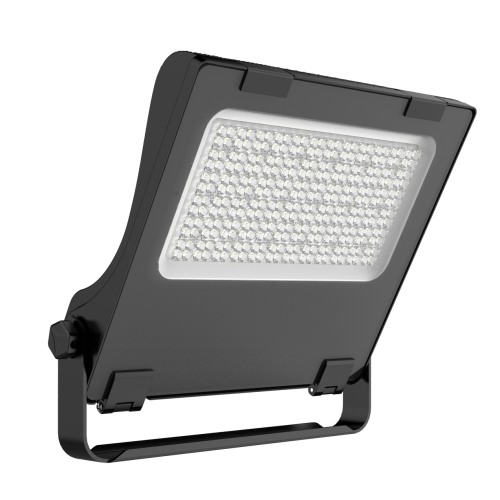
FALON in six sizes from 28 to 322 W, with 5 beam angles from 20° to 90° and 6 asymmetric optics – bigboards included. Efficacy up to 174 lm/W, IP 66 rating, IK 08 and a 5-year warranty.
Billboards and double billboards
Floodlights for advertising panels
FARA II from 40 to 240 W with beam angles of 30 × 60° and 65 × 120° for poster panels, with DALI or 1 – 10 V dimming. FARA for advertising panels from 100 to 240 W for walls, billboards and double billboards.


Installation and controls: light from above, and only when it makes sense
We mount the floodlights on brackets above the panel and light it from the top down. The light lands on the poster rather than in the sky – less light pollution and no glare for passers-by. A timer or a photocell switches the advert on at dusk and can dim it or turn it off later at night.
- bracket mounting above the panel – no light above the horizontal
- narrow and asymmetric optics to suit the size of the panel
- photocell and timer – switch-off after midnight
- DALI or 1 – 10 V dimming with FARA II
- IP 66 rating and IK 08 impact resistance for outdoor use
- discharge lamps replaced with LED on the existing brackets
Case study
Dozens of Imagewell bigboards
Imagewell lit its advertising panels with 248 discharge floodlights of 250 W, drawing 270 W each with their ballasts. We replaced them with the same number of 50 W LED floodlights with a 60° beam angle, which draw 64 W including their Mean Well drivers. The panels are lit 11 hours a day all year round – so the savings showed up straight away.
Before
- 248 discharge floodlights
- 66,960 W in total
- annual lamp replacement
Solution
- 248 LED floodlights, 50 W, 60°
- 15,872 W in total
- no lamp replacement

lighting power input
annual savings on energy
annual savings on maintenance
total cost savings
How we work
Site survey
Size and type of panel, brackets, power connection and surroundings – road, houses, other lights.
Calculation
Number, output, optics and tilt of the floodlights, so that the panel is evenly lit and stays within the luminance limit.
Quotation with savings
Price, energy consumption before and after the changeover and payback – across the whole network where there are several panels.
Installation
Replacement on the existing brackets or new brackets, plus setting up the switching.
Warranty and service
A 5-year warranty on FALON, FARA II, FARA III and RONIN floodlights.
More lit advertising panels
All projects →FAQ
What owners and operators of advertising panels ask us.
How much will I save by replacing discharge lamps with LED?
On the Imagewell bigboards the power input per luminaire fell from 270 W to 64 W, a drop of 76% overall. At 11 hours of operation a day that came to €28,638 a year on energy and a further €4,504 on maintenance. We will work out the exact savings for your panels from the number of floodlights and the hours they run.
How many floodlights does a billboard or a bigboard need?
It depends on the size of the panel, the bracket spacing and the optics. On the advertising panels in our projects we supplied 7 to 8 floodlights of 30 to 40 W per panel. We determine the exact number for your panel in a lighting calculation.
Light it from below or from above?
We recommend lighting from the top down. The light lands on the poster, and whatever misses it goes to the ground rather than into the sky. With uplighting some of the light escapes above the horizontal and can cause glare.
Which colour of light should I choose?
Most often 4,000 to 5,000 K. Neutral to daylight white renders the colours of most campaigns faithfully. For adverts with warm tones, 4,000 K works well.
Can an advert stay lit all night?
Technically yes, but it often makes little sense. A timer turns the advert off or dims it in the small hours, when there is hardly anyone about – you save money and cut light pollution. The planning consent for the advertising structure may also set conditions.
Can new floodlights be fitted to the existing brackets?
Usually yes. LED floodlights are lighter than discharge ones and have an adjustable mounting bracket. If the tilt or the bracket spacing is unsuitable, we will propose a modification.
From our blog
All articles →Related solutions