Pedestrian crossing lighting
At a crossing the driver has to see the pedestrian in time – in the rain, at five in the afternoon in winter, and when the pedestrian is wearing a dark coat. Ordinary street lighting turns a pedestrian into a dark silhouette against a bright road surface. Dedicated crossing lighting lights them from the front, so the driver sees a bright figure instead.
We design, supply and install LED pedestrian crossing lighting with special asymmetric optics – for new crossings and as part of street lighting refurbishment in your town or village.

asymmetric SILVA PRO optics for crossings – the light is aimed at the pedestrian as the driver sees them
in a single SILVA PRO luminaire – for the crossing and the road in the same design
impact resistance, with an IP 66 rating on crossing luminaires
warranty on street lighting luminaires
Why a crossing needs lighting of its own
Street luminaires light the road from above. The driver sees bright tarmac with the pedestrian on it as a dark shadow – negative contrast. Crossing lighting reverses this: the light falls on the pedestrian from the front, from the approaching car’s point of view, and the pedestrian stands out against a darker background.
Pedestrian lit from the front
What matters is the light falling on the pedestrian’s body (vertical illuminance), not just on the road. It has to be significantly higher than the lighting of the surrounding road.
Light from the driver’s point of view
The luminaire stands ahead of the crossing in the direction of travel – on two-way roads on both sides of the road, each one serving its own lane.
No glare
The asymmetric optic sends light onto the crossing and the pavement, not into the eyes of the driver or the pedestrian. Only the crossing and a narrow strip around it are lit.
Visible from a distance
A clearly lit crossing is noticed sooner – and the driver slows down. A different colour temperature helps too, setting the crossing apart from the rest of the street.
How to light a crossing properly
The requirements for road lighting, including crossings, are set out in the EN 13201 series of standards, supported by the technical specifications that apply to public roads. In practice five things decide the outcome – from where the pole goes to how the lighting is controlled.
We determine the exact position, height and tilt of the luminaires for each crossing in a lighting calculation.
| WHAT | HOW |
|---|---|
| Position | ahead of the crossing in the direction of travel, on both sides on a two-way road |
| Optic | asymmetric distribution for crossings – left or right depending on the side of the road |
| Level | light on the pedestrian’s body significantly higher than on the surrounding road |
| Coverage | the crossing and the waiting areas on both sides, not the whole stretch of road |
| Controls | the crossing runs at full output all night, or boosts its output when a pedestrian is detected |
Luminaires for crossings
For the crossing we use a luminaire from the same range as the one on the street, only with a special optic – so the town keeps a consistent look and a single type of spare part.
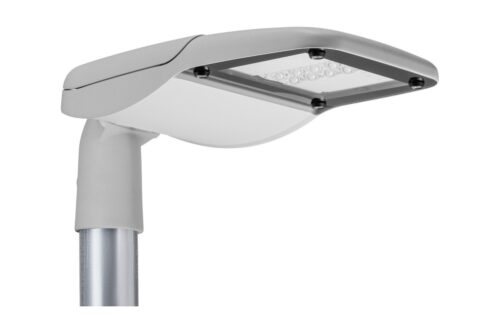
Pedestrian crossings
SILVA PRO with PR and PL optics
Asymmetric PR and PL distributions made for crossings – for both the right and the left side of the road. Power input from 13 to 179 W, IP 66 rating, IK 09 resistance, ± 15° tilt, DALI, D4i and a Zhaga connector for a sensor as options.
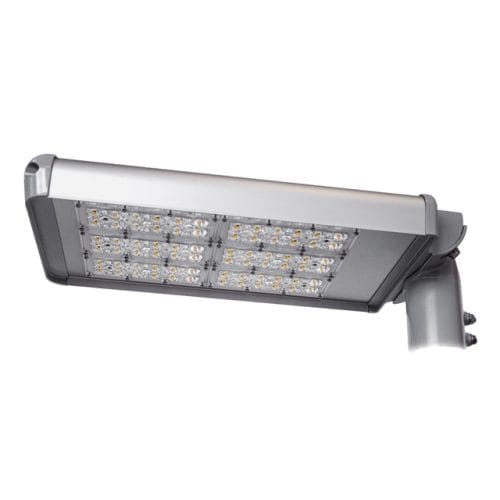
Crossings and roads
SARA and STELA
We supplied SARA with a special optic for mounting at crossings to Elpromont Tatry, among others. For the surrounding road, STELA and STELA MINI with asymmetric optics and efficacy of up to 174 lm/W.

Crossings with no power connection
Solar luminaires and poles
A crossing on the edge of the village or by a bus stop, with no street lighting cable running to it, can be lit by the solar SOLAR FLEXI with a motion sensor. We also supply poles with a bracket to reach over the crossing.
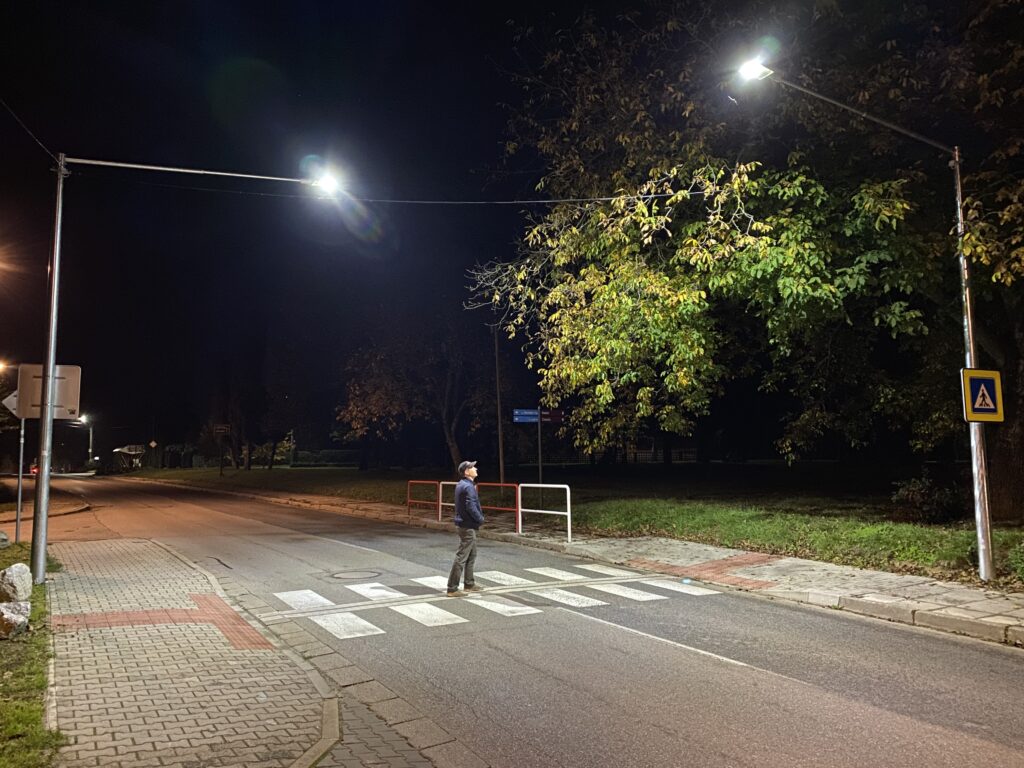
Smart crossing: more light when someone is on it
The street can dim at night, but the crossing should stay at full output. If the luminaire has a sensor, it can raise the lighting level the moment a pedestrian arrives at the crossing and alert the driver that way. The technical specification on traffic calming in built-up areas recommends raising the lighting level by 60% at smart crossings once a pedestrian is detected.
- no dimming on the crossing, dimming on the street
- pedestrian sensor via a Zhaga or NEMA connector
- light boost on detection
- DALI and D4i for connection to the town’s control system
- a separate circuit for crossings
- constant luminous flux over the service life
Case study
New crossings in Trenčianska Turná
Together with SAZOS we replaced the old metal halide luminaires in the village of Trenčianska Turná with LED street lighting and lit the new pedestrian crossings. We used a range of luminaire versions and wattages from 18 to 56 W with colour temperatures from 4,000 K to 5,700 K – the crossings are now visible from a distance and residents and visitors alike cross the road more safely.
Before
- metal halide luminaires
- new crossings with no lighting
Solution
- LED luminaires from 18 to 56 W
- lighting for the new crossings
- 4,000 – 5,700 K depending on location
luminaire wattage
colour temperature
colour rendering index
year completed
How we work
Site survey
We look at the crossing and its surroundings after dark – existing columns, power connections, bus stops, entrances.
Calculation
The position, height and tilt of the luminaires and the choice of optic, set out in a DIALux calculation.
Quotation
Luminaires, poles, brackets, controls and installation in a single quotation.
Installation
Poles and luminaires fitted with only a brief disruption to traffic.
Warranty and service
A 5-year warranty on the luminaires, plus servicing and spare parts.
More projects
All street lighting projects →FAQ
What towns, villages and road authorities ask us about crossing lighting.
Why isn’t ordinary street lighting enough?
A street luminaire lights the road from above, so the pedestrian appears to the driver as a dark silhouette against a bright background. A dedicated luminaire ahead of the crossing lights the pedestrian from the front, and the driver sees them sooner and more clearly.
Where should the luminaire stand?
Ahead of the crossing in the direction of travel, so that it lights the pedestrian from the approaching driver’s point of view. On a two-way road there is a luminaire on both sides. The exact position, height and tilt are determined by the lighting calculation.
Can a crossing be lit from an existing column?
Sometimes it can, if the column stands on the right side and at the right distance from the crossing. Often it is better to install a new pole with a bracket – we assess this during the site survey.
What if there is no cable running to the crossing?
At crossings on the edge of a village or by a bus stop, the solar SOLAR FLEXI with a motion sensor can be used. We check that it is suitable for the location and any shading.
Who approves the lighting of a crossing?
Crossing lighting forms part of the project documentation, which is approved by the road authority and the traffic police. We prepare the lighting calculation as supporting material for the project.
What warranty do you provide?
5 years on street lighting luminaires, including SILVA PRO and SARA. The service life of the LED luminaires is 100,000 hours.
From our blog
All articles →Related solutions