Lighting for roads and streets in towns and villages
Street lighting is one of the largest items in a local authority’s electricity budget – and it is also what residents see every evening. Old discharge lamps are expensive to run, light unevenly and often fail altogether. An LED installation designed to the standard gives better light at a fraction of the cost.
For municipalities, towns and highway authorities we design, supply and install LED street lighting for roads and streets to EN 13201 – from asset survey and audit through the lighting calculation to replacing luminaires and poles and setting up controls with dimming.

less electricity for street lighting in the town of Gbely after 499 discharge-lamp luminaires were replaced with LED
payback on the investment in Gbely – savings of €22,291 a year on energy and maintenance
towns and villages in Slovakia and the Czech Republic with our LED street lighting
efficacy of SILVA PRO luminaires, available with nine optics for roads
What road lighting has to do
A main road through a village, a residential street and a footway all need different light. That is why EN 13201 divides roads into classes according to speed, traffic volume and who uses them. A good design meets the class on every section – and nowhere puts out more light than it needs to.
The right class to the standard
We assign every section to a lighting class under EN 13201 and choose the luminaire so that it meets that class – road surface luminance on carriageways, illuminance on streets and footways.
Uniformity
Alternating bright and dark patches are more dangerous for a driver than a lower overall light level. Asymmetric optics spread the light evenly even where poles are far apart.
No glare or light pollution
Luminaires with no upward light output do not shine into windows or up at the sky. We choose the colour temperature to suit the location – 4,000 K on main routes, 3,000 K in residential streets.
Low running costs
Fewer watts, dimming overnight, no lamp changes and fewer distribution boards. In Gbely the power input of the whole installation fell from 63.1 to 22.8 kW.
Lighting classes under EN 13201
On roads carrying motor traffic (M classes) the criterion is the luminance of the road surface as the driver sees it. On residential streets, footways and cycle tracks (P classes) what matters is illuminance – how much light reaches the surface. The class for each section is set by the designer according to speed, traffic volume and surroundings.
The table shows a selection of classes with typical applications. We determine the exact class for each section and the luminaire for each pole in the lighting calculation.
| CLASS | REQUIREMENT AND TYPICAL APPLICATION |
|---|---|
| M3 | road surface luminance 1.0 cd/m² – main road through a village with heavier traffic |
| M4 – M5 | 0.75 – 0.5 cd/m² – distributor and access roads |
| P2 – P3 | 10 – 7.5 lx – village centre, town square, busy footway |
| P4 – P5 | 5 – 3 lx – residential streets, footways and cycle tracks with lighter use |
Luminaires for roads and streets
A single range of luminaires with different wattages and optics covers both the main road and the residential street – so the village gets a consistent look and simpler maintenance.
Roads and streets
Street lights
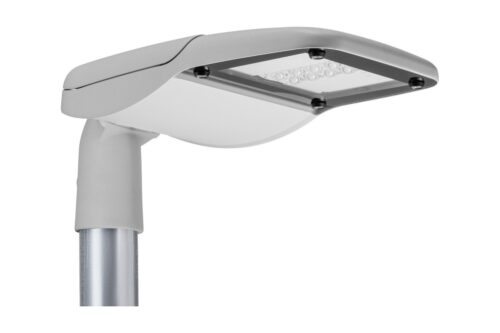
SILVA PRO in four sizes from 13 to 179 W with nine optics for M and P classes, IK 09 and operation down to −40 °C. STELA and STELA MINI with efficacy up to 174 lm/W, SARA up to 181 lm/W, plus the budget-friendly STEFFI and SILVA ECO. We supply poles as well.

Village centres and town squares
Decorative luminaires
URBAN II combines LED technology with a traditional lantern shape – for historic centres, squares and pedestrian zones where appearance matters too. Power input of 34 to 66 W, toughened glass and low glare.

Protected areas and village edges
Wildlife-friendly luminaires
NICOLE Bat with amber light and no UV radiation for locations where bats are present. NICOLE Mesopic with a spectrum tuned to vision in low light. Made by the Dutch manufacturer Innolumis, with a service life of 100,000 hours.

Controls: light to suit the hour, not out of habit
At midnight only a fraction of people are driving or walking through the village, yet old lighting burns at full output until morning. Modern street lighting controls reduce the output during the quiet hours and switch the system on exactly when it gets dark – not in broad daylight, as often happens in villages.
- astronomical time switches and photocells
- standalone dimming to a night-time profile
- constant luminous flux throughout the service life
- DALI, D4i and Zhaga/NEMA connectors for smart city use
- fewer distribution boards and supply points once circuits are linked
- no upward light output
Case study
Street lighting for the town of Gbely
The town was lit by 499 sodium and compact discharge lamps with an average power input of 126.4 W, mounted on steel poles and on concrete power-line poles. The audit found that 30 luminaires were not working at all, that the output of the rest had fallen with age to as little as 60% and that uniformity did not meet EN 13201. We replaced them with 500 LED luminaires – 95 × 56 W on the main roads and 405 × 28 W on side streets – switched by astronomical time switches and photocells.
Before
- 499 discharge lamps, 126.4 W on average
- 30 luminaires out of action
- 63.1 kW, 8 distribution boards
Solution
- 500 LED luminaires at 28 W and 56 W
- astronomical time switches and photocells
- 22.8 kW, 4 distribution boards

less electricity
saved each year on energy and maintenance
payback on the investment
distribution boards and supply points
saved over the service life of the luminaires
less CO₂ over the service life
How we work
Asset survey and audit
We map every lighting point, distribution board and the energy consumption. A street lighting audit shows what is not working and what the system costs to run.
Calculation to the standard
Every section is assigned an EN 13201 class and every pole gets its luminaire in the DIALux calculation.
Quotation with payback
The investment, the savings on energy and maintenance and the payback – ready to put before the council or to support a grant application.
Installation street by street
Luminaires swapped on the existing poles, or new poles where needed, with no lengthy blackout.
Warranty and service
A 5-year warranty on street lighting luminaires, or 10 years on STELA for a surcharge.
More towns and villages
All street lighting projects → Trenčianska Teplá79 luminaires at 26 W and 62 W on the main roadLED luminaires replaced 125 W sodium lamps and compact fluorescent lamps – lower costs and more even light on a busy road.
 Town of Gbely500 LED luminaires, 63.8% less electricityA town-wide replacement of 499 discharge-lamp luminaires with LED, paying for itself in 5.3 years.
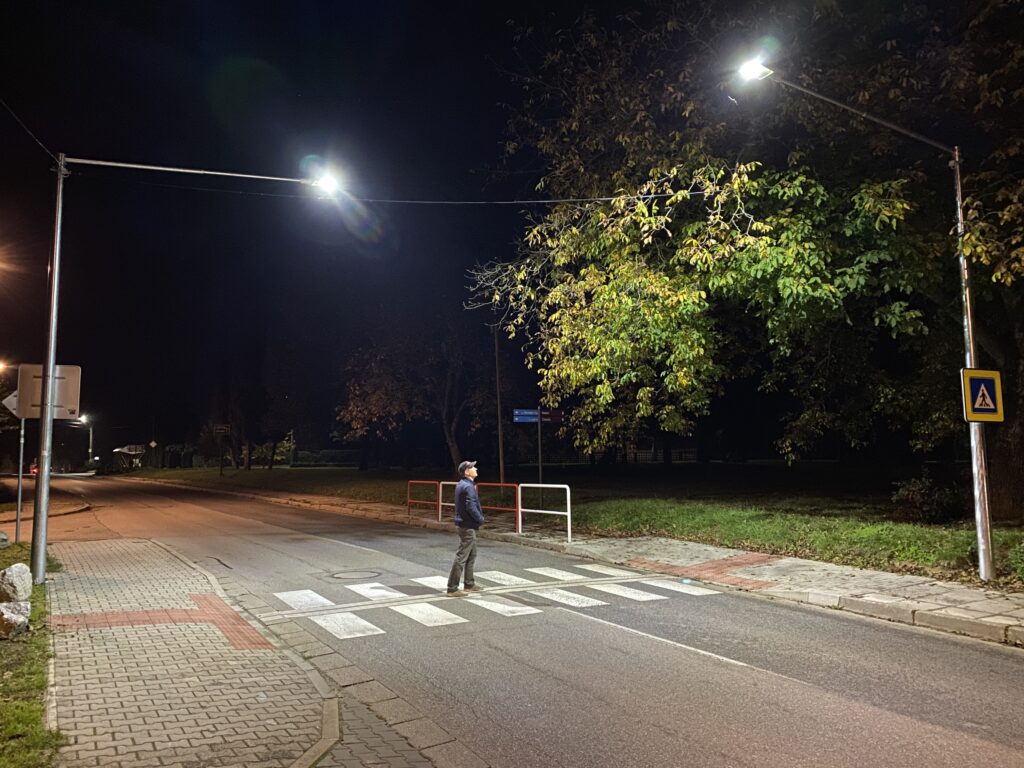 Trenčianska TurnáLED street lighting from 18 to 56 WWorking with SAZOS, we replaced metal halide luminaires with LED and lit the village’s new pedestrian crossings.
Village of Ochtiná83 × SARA at 25.6 W and 38 WA street lighting refurbishment using luminaires with a pre-programmed dimming profile.
Rychnov nad KněžnouNICOLE and NICOLE miniWith our partner DATmoLUX we replaced the town’s luminaires with LED, matching wattage and spectrum to the class of each road.
Rovinka residential district44 luminaires at 30 WStreet lighting for a newly built residential district, delivered together with ELEX.
FAQ
What mayors and highway authorities ask us most often.
Who decides which lighting class our street needs?
The class under EN 13201 is set by the designer, based on speed, traffic volume, pedestrian movement and the road’s surroundings. During the audit and design we do this for you for every section and choose luminaires that meet the class.
Can we just replace the luminaire on the existing pole?
In most villages, yes – on steel poles and on concrete power-line poles alike. The luminaires have an adjustable tilt and reducers for different bracket diameters. If a pole is in poor condition or missing, we supply a new one.
How much will our village save?
It depends on the existing installation. In Gbely consumption fell by 63.8% and the savings on energy and maintenance come to €22,291 a year, with a payback of 5.3 years. You will get exact figures for your village in the quotation once the audit is done.
Which colour temperature should we choose?
Neutral white at 4,000 K suits main routes, while a warmer 3,000 K works better in residential streets and centres, where it is more pleasant and easier on the surroundings. In protected areas and where bats are present we recommend the amber NICOLE Bat luminaires.
Will you help with grant documentation?
We prepare the asset survey, the design and the savings calculation. If the call for proposals requires an energy audit, we will arrange it through a registered energy auditor.
What warranty do you offer?
5 years on street lighting luminaires including STELA, STELA MINI, SILVA PRO and SARA, or 10 years on STELA for a surcharge. The service life of the LED luminaires is 100,000 hours.
From our blog
All articles →Related solutions