LED and safe towns and cities
LED street lighting is a very promising field. Low consumption, long service life, freedom from maintenance and modern design are its main features. Opinions differ, however, on the quality of LED technology as such. What does this mean for municipalities and cities considering replacing old street lighting systems with new ones? We bring you an overview of the most important safety aspects of LED street lighting – with it, you will be able to choose the most suitable and efficient lighting for your town or city.
Street lighting plays an important role in the safety of our streets and public spaces (roads, cycle paths, parks, residential areas…). When we think of street lighting and safety in the city, many of us picture luminaires with a good light output. But that is far from everything. Let us look at which aspects of street lighting are essential for assessing its safety.
Efficient lighting
The basis is well-chosen and correctly positioned lighting. Choosing the right lighting (luminaires designed for the specific purpose) means lower costs and less light pollution for the municipality or city. “Correct lighting” also includes a suitable illuminance, luminance, light colour and proper light direction. Lighting efficiently also means lighting appropriately – neither too much nor too little. And, of course, at the right time: controlling lighting throughout the day is a necessity today.
What are the benefits of efficient lighting for the public? More pedestrians and cyclists create a positive environment, and streets are used more and vandalised less. Better visibility reduces crime and vandalism. On roads and pavements you can see what you need to see – a correctly chosen lighting system reduces the number of accidents.

Glare
Glare occurs when there are excessive luminances or luminance contrasts in the field of vision that the eye cannot adapt to. Glare impairs the visibility of details and the dazzled person loses visual comfort. Eliminating glare is important not only for visual comfort but also for safety. Glaring light draws attention away from objects or people who should be visible at that moment but are not – a pedestrian, a road sign, an uneven road surface or an object on the road.
A well-chosen lighting system does not direct light into the eyes of drivers, cyclists or pedestrians, but onto the road surface and the pedestrian area. Glare can be eliminated by choosing suitable light sources and luminaires and by positioning the poles correctly.
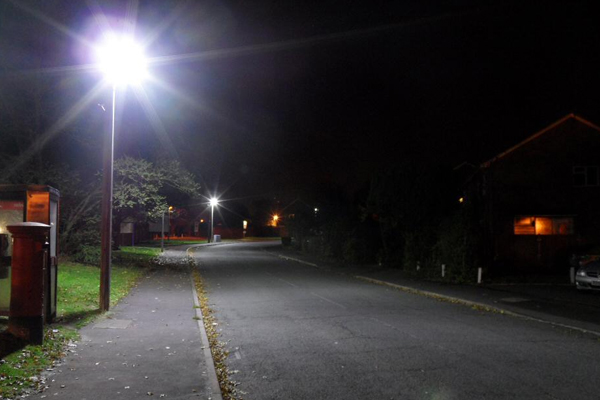
As Mario Motta, president of the Massachusetts Medical Society, puts it with some exaggeration, glare from poor lighting is a public health hazard. Besides its adverse effect on eyesight (especially in older people), glaring light causes a loss of contrast and creates dangerous conditions for drivers. The consequences are often much worse than being dazzled through a dirty windscreen by a low sun or by the headlights of a high oncoming vehicle…
Light that is too harsh along roads can partially blind road users and contribute to more frequent accidents. Unfortunately, it is well known that not every street light has good-quality optics and produces light that is visually comfortable for drivers, cyclists and pedestrians. The trend is positive, though – more and more LED luminaires are designed to partially or fully eliminate the “glare effect”. Why? Controlling luminous intensity, and therefore glare, is becoming easier. The light-emitting part is a flat surface set deeper inside the luminaire, which reduces the number of angles from which the light source can be seen – and from which it can dazzle us.
Uniformity of lighting
The ratio of the minimum to the average illuminance of a surface is called lighting uniformity. Uniform lighting has a major influence on visual comfort, i.e. the state in which the visual system works optimally. Glaring or uneven lighting reduces visual comfort and affects the safety of people and vehicles. When designing a lighting system, emphasis should therefore be placed on uniformity and on the visibility of critical details against the road background.
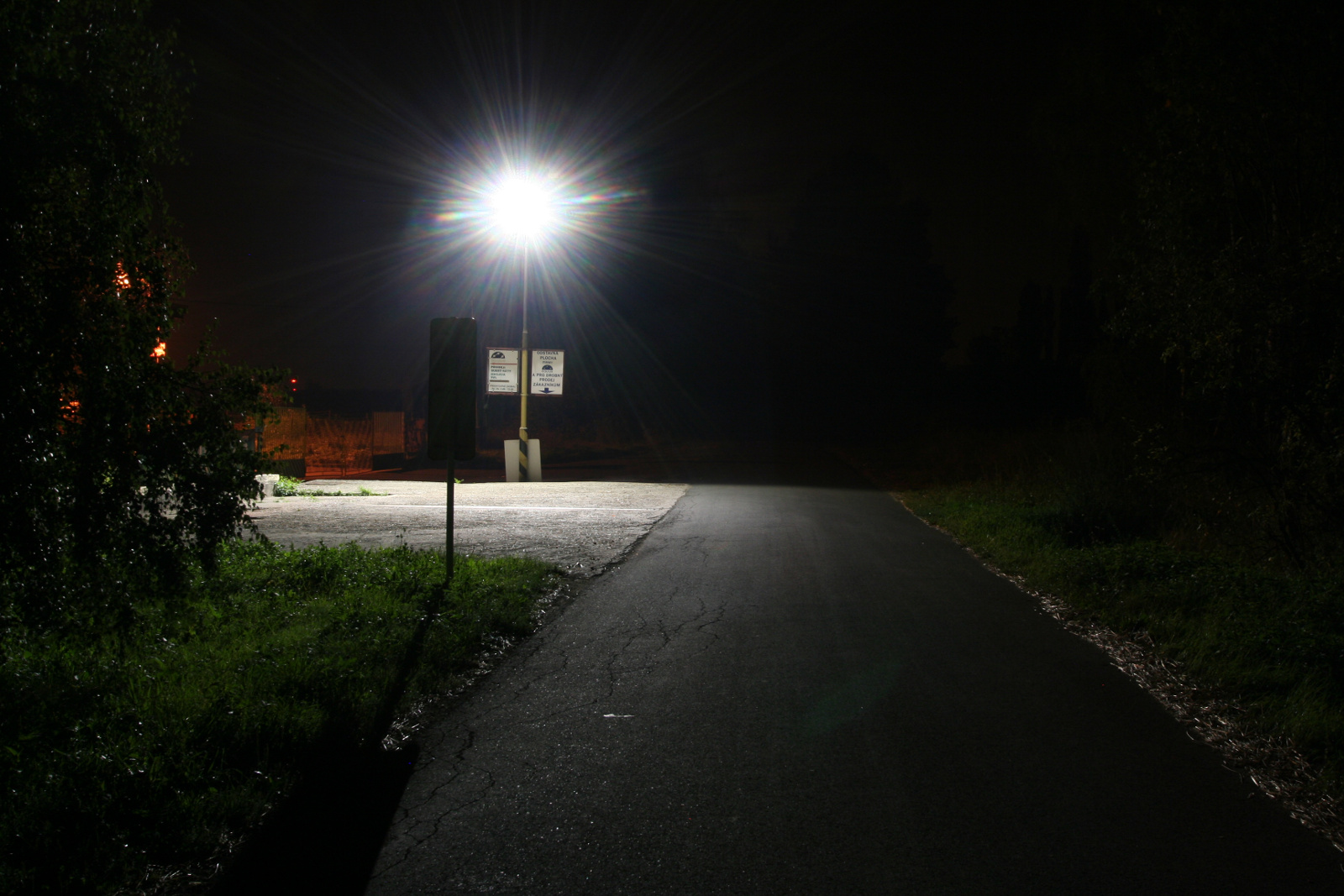
The human eye perceives evenly lit roads, cycle paths and pavements as a single, continuous space. It does not get tired, because it is not strained by constantly adapting to different luminance levels. Evenly lit roads allow road users to spot obstacles in time and react to situations more quickly.
Poor-quality, wrongly chosen or incorrectly installed lighting can cause unpleasant glare and create abrupt transitions between brightly lit spots and dark shadows. The combination of intense light and deep shadows can give rise to dangerous situations. We should also not forget that uneven lighting is a heavy burden, especially for the eyes of older people. The solution is to reduce the intensity at the brightest spots, so the eyes can better adapt to the darker areas around them.
Sources:
- http://www.cree.com/~/media/Files/Cree/LED%20Components%20and%20Modules/XLamp/XLamp%20Application%20Notes/LED_Luminaire_Design_Guide.pdf
- http://svetelneznecisteni.cz/co-je-svetelne-znecisteni/bezpecnost/
- http://www.idbjournal.sk/rubriky/prehladove-clanky/skusenosti-s-led-svietidlami-vo-verejnom-osvetleni.html?page_id=19544