Correct colour rendering
For a sense of visual comfort, it is important that the colours of people and objects in the environment look natural. The naturalness of colour rendering is measured by the lighting parameter known as the colour rendering index Ra (CRI). Sunlight has an index value of 100 Ra. Artificial lighting is always compared with daylight (sunlight), and the index expresses the percentage representation of all colours.
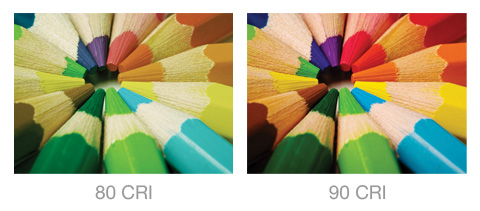
If an artificial light source has an index value of, say, 70 Ra, it means that the colours of objects lit by it look noticeably different from how they look under the reference light. Ra is not a percentage of wavelengths – it indicates how faithfully a source renders eight standard colour samples compared with a reference light of the same colour temperature (the maximum is 100). It could also be said that CRI indicates how closely the actual colour of an object matches its colour when lit by different light sources. Be careful, however, not to confuse CRI with colour temperature, which is an entirely different quantity. You can easily find two light sources with the same light colour but different CRI values.

The essence of CRI is the reflection of light from individual materials (the reflection of radiation of various wavelengths from the observed objects). We perceive a blue object as blue precisely because the wavelength corresponding to blue is reflected from it. You will no doubt remember your teachers saying that colours are not real but exist only “in our eyes”.
People’s decisions are often influenced by their perception of colour without them even realising it. One example is the use of luminaires with a high CRI to light food in shops, making it look healthier and tastier. In street lighting, however, CRI is often an overlooked lighting parameter. Manufacturers mostly produce lighting that meets the minimum Ra values for a given type of environment (halls, offices, roads…), as raising the index value is considerably more expensive for them.
And why is correct colour rendering so important? For road safety, for example, for recognising obstacles in time, for visual comfort and for not damaging our eyesight. And, to no small extent, for faithful colour reproduction on security cameras, whose main task is to recognise objects in colours as true to life as possible.
Multishadow effect
The term “multiple shadows” is becoming increasingly well known in Slovakia too. A luminaire with a single light source (e.g. an incandescent bulb) creates only one shadow of an object. LED technology, however, works differently. The luminaire contains an array made up of several small LEDs. This means that, if the luminaire’s optics are of poor quality, multiple overlapping shadows can very easily occur.

The multishadow effect is therefore a side effect of many lower-quality LED street luminaires. It occurs when the light source is “broken up” into several smaller light-emitting parts, each with its own sharply directed luminous flux. These beams of light are in fact very close to one another, yet each creates its own shadow. The light therefore does not appear uniform, and the result is a blurred shadow of the objects or people within reach of such a luminaire.
The multishadow effect is unpleasant for both human vision and the mind. The outlines of the shadows look blurred to the eye, so it keeps trying to refocus. Essentially, the brain thinks there is something wrong with our eyesight. An object moving beneath the luminaire creates multiple shadows, sometimes even a stroboscopic effect. This confuses the brain and tires the eyes, and a person may mistake one of the shadows for a real object. The subconscious reflex to avoid it can cause an accident.
With the arrival of new types of LED luminaires, however, the problem of multiple shadows is gradually disappearing. This undesirable phenomenon can be eliminated by means of:
- a diffuser glass, i.e. a cover (whose role is to diffuse the light) placed at a precise distance from the LEDs,
- a suitable cover surface,
- LEDs with precise spacing.
Until recently, the cover (clear or frosted) was not placed at a precise distance from the LEDs, and this distance was determined only by the aesthetic or structural features of the luminaire. Likewise, the density of the individual LEDs was merely a question of lighting intensity. Today, however, these parameters are optimised with the aim of eliminating multiple shadows.
New luminaires mainly use a clear cover with a smooth surface or a cover with small protrusions (e.g. pyramid-shaped). The arrangement of the point sources (LEDs), their beam angle, distance from the cover and the pattern (surface structure) of the cover are precisely defined. Together, all of this ensures a continuous, even overlapping light footprint – with no multiple shadows.
FreyaLED and safe lighting
And what about FreyaLED and safe LED street lighting? We closely follow the range of LED street luminaires available on the market and select the individual products for our range very carefully. We continually update our portfolio and thus keep pace with newly developing LED technologies.
One of the most suitable luminaires for safe street lighting in towns and villages is undoubtedly the Nicole luminaire, with high-quality optics and in various versions (with RGB LEDs or pure white CREE-type LEDs). It really highlights objects on the road nicely, the light feels pleasant and does not cause glare. The colours of objects compared in daylight and under Nicole’s artificial lighting are almost identical.

Sources:
- http://skpatents.com/6-u5655-sposob-eliminacie-tvorby-viacnasobnych-tienov-pri-svietidlach-s-bodovymi-zdrojmi-svetla-najma-led-svietidiel.html
- http://www.cree.com/~/media/Files/Cree/LED%20Components%20and%20Modules/XLamp/XLamp%20Application%20Notes/LED_Luminaire_Design_Guide.pdf
- http://svetelneznecisteni.cz/co-je-svetelne-znecisteni/bezpecnost/
- http://www.idbjournal.sk/rubriky/prehladove-clanky/skusenosti-s-led-svietidlami-vo-verejnom-osvetleni.html?page_id=19544