Lighting for parking garages and underground garages
A driver comes in from daylight into darkness and the eye needs time to adapt. That is exactly why the ramp carries the highest levels in the whole building during the day – and the lowest ones at night. The rest of the parking garage is lit around the clock, so every watt you save counts for 8,760 hours a year.
For operators of parking garages, underground garages and residential buildings we design and supply dust-tight linear luminaires, lighting for ramps and entrances, sensor-based controls and emergency lighting for escape routes.
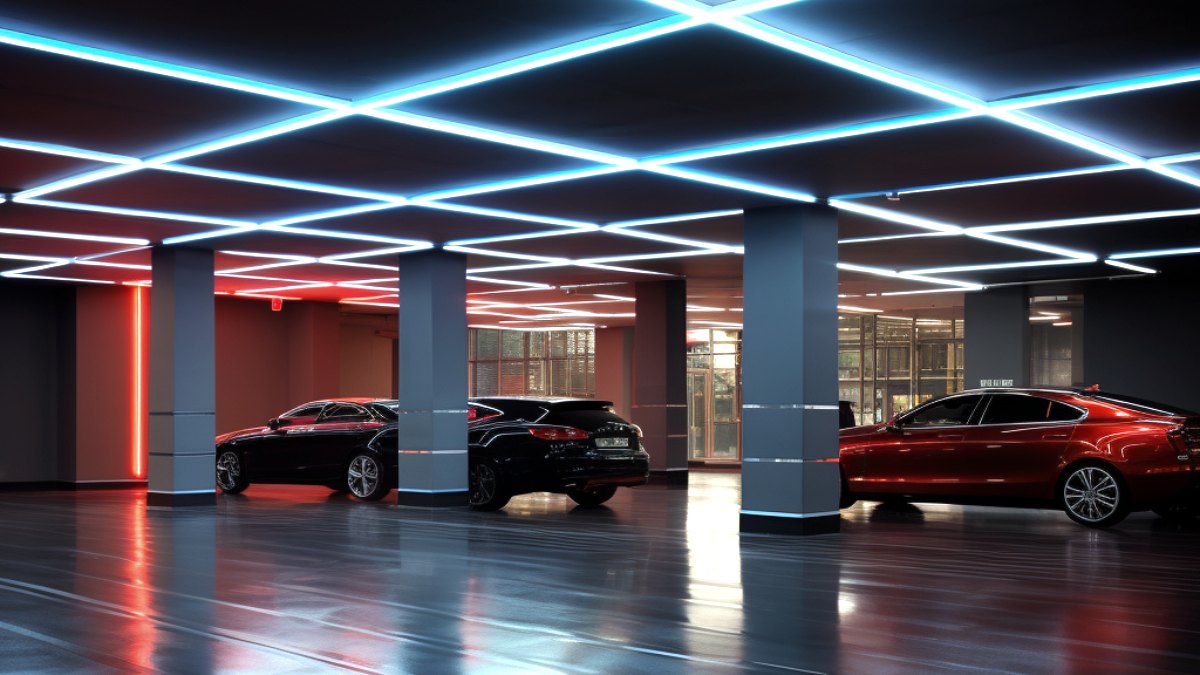
on the entrance ramp during the day – the eye moves from daylight into the interior
traffic lanes, parking bays and the ramp at night
rating of LENA ECO+ luminaires against dust and splashing water during washdowns
how many hours a year a garage with no daylight stays lit – which is why sensors pay back fastest here
What parking garage lighting has to do
A parking garage is a space with no daylight, used by cars and people alike, and washed down with pressurised water. Those are three completely different demands on a single luminaire.
The light-to-dark transition
During the day the ramp is at 300 lx so the eye has time to adapt coming in from outside. At night 75 lx is enough, otherwise the ramp would cause glare instead. This is solved by controls, not by changing luminaires.
Safety and cameras
The standard points out that high vertical illuminance improves facial recognition and with it the feeling of safety. It also helps the CCTV system.
Dust, exhaust fumes and washdowns
A luminaire in a garage collects dust from exhaust fumes and has to cope with floor washing. That calls for dust-tight bodies with an IP 65 rating or higher and a smooth diffuser.
Round-the-clock operation
With no daylight, a garage stays lit all year. Sensors, corridor function and night-time dimming are the quickest route to a lower bill here.
How much light a parking garage needs
The requirements for covered parking areas are set by EN 12464-1. Interestingly, they are fairly low – 75 lx everywhere apart from the ramp during the day – but they are measured at floor level and the standard explicitly requires safety colours to remain identifiable.
The colour rendering index here is only Ra ≥ 20, the lowest value anywhere in the standard. In practice that does not mean it pays to go to the limit – safety markings, lines and the colour of a car all need to be legible.
These values are indicative. The exact solution for your building is determined in a lighting calculation.
| ILLUMINANCE | SPACE |
|---|---|
| 300 lx | entrance and exit ramps during the day |
| 75 lx | ramps at night |
| 75 lx | traffic lanes |
| 75 lx | parking bays |
| 300 lx | pay station and attendant (UGR ≤ 19, Ra ≥ 80) |
| 1 lx | escape routes – emergency lighting to EN 1838 |
Which luminaires suit a parking garage
The basis is dust-tight linear luminaires over the traffic lanes and bays. They are complemented by sensor-based controls, ramp lighting and emergency luminaires on the escape routes.

Traffic lanes and bays
Dust-tight linear luminaires
LENA ECO+ with an IP 66 rating, efficacy of up to 185 lm/W and a service life of over 100,000 hours. The polycarbonate body copes with damp and with washing, and it is made in lengths of 60, 120 and 150 cm.
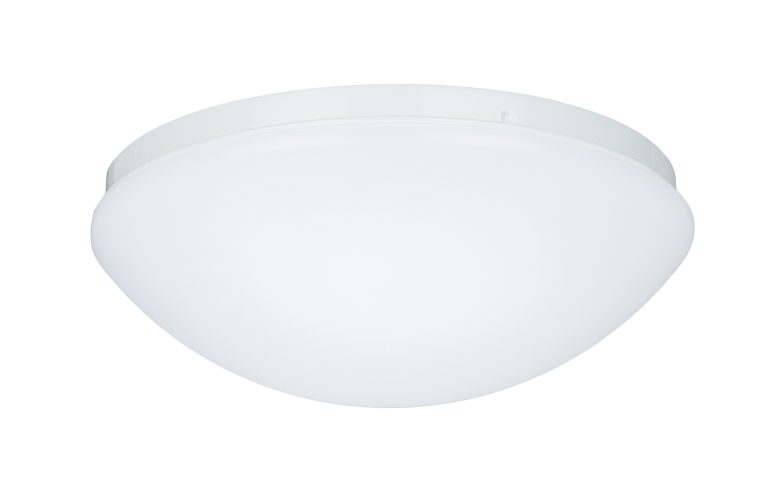
Less busy levels
Sensor luminaires
SENZO and SANDRA with a motion sensor wherever parking comes in bursts. LENA luminaires are also available in a version with a sensor, so the controls need no separate system.

Entrance, ramp and surroundings
Floodlights and street lighting
FALON and FARA III floodlights for the ramp and the entrance portal, STELA MINI and SILVA PRO for the access road and the outdoor bays in front of the building.

Controls: a garage does not have to run at full output
A parking garage is a space where nobody is moving about most of the time. And yet it is lit continuously. This is where lighting controls have the shortest payback of anything in our portfolio – and where they must never come at the expense of how safe people feel.
- motion sensors on levels with intermittent traffic
- corridor function – the luminaire comes up smoothly, not in a jump
- a base light level that never drops to zero
- the ramp: a higher level during the day, dimmed at night
- DALI dimming wherever a whole level needs to be controlled at once
- we supply the design and programming of the controls as a separate service
Emergency lighting and escape routes
In a garage with no daylight, a power cut means complete darkness. Emergency lighting here is not a formality – it is the only thing that will show people the way out.
- 1 lx along the centre line of the escape route to EN 1838
- ZERO II with an IP 66 rating and IK 08 impact resistance for the garage itself
- ZARA in versions for escape routes and for open areas
- self-contained operation for 1 or 3 hours after a power cut
- a self-test button, an autonomous testing system or central monitoring
- the option of connecting to a central battery
Space by space
What we would put into a parking garage
This is what a typical design for the underground garage of a residential or office building looks like. Exact quantities and outputs only follow from a site survey and a calculation – this is a map showing which luminaire belongs where, and why.
Inside
- traffic lanes
- parking bays
- ramps and bends
- staircases and lift lobbies
Around
- entrance portal
- access road
- outdoor bays
- plant rooms
How we work
Site survey
We walk the levels, ramps and escape routes. We measure what is lighting them today and look at the state of the wiring.
DIALux calculation
Illuminance at floor level, uniformity and ramp lighting for both the daytime and the night-time setting.
Quotation with savings
Luminaires for the whole building, energy consumption before and after, and payback including the effect of the sensors.
Installation
Level by level or section by section, so the garage stays open and drivers still have somewhere to park.
Warranty and service
A 5-year warranty on street lighting luminaires and floodlights, 2 years on emergency luminaires.
FAQ
What building managers and owners’ associations ask us.
How much light should there be in a parking garage?
EN 12464-1 requires 75 lx on traffic lanes and parking bays, and 300 lx on the entrance and exit ramp during the day, dropping to 75 lx at night. The values are measured at floor level and the standard explicitly requires safety colours to remain identifiable.
Why should the ramp have more light than the rest of the garage during the day?
Because the eye arrives from daylight, which runs to several thousand lux even on an overcast day. If the ramp were at the same level as the rest of the garage, for a moment the driver would see it as darkness. At night it is exactly the other way round – then the same level would cause glare.
Are sensors worth it when the garage is used all day?
It depends on the level. On a busy level near the entrance a sensor saves almost nothing; on the top or bottom level the effect is usually substantial. That is why we do not specify sensors across the board, but where they make sense – and always with a base light level that does not drop to zero.
What IP rating should a luminaire in a garage have?
For a space where the floor is washed down and dust from exhaust fumes settles, we choose luminaires with an IP 65 rating or higher. LENA ECO+ has IP 66 and a polycarbonate body that copes with damp and with impacts.
What difference does a replacement make to energy bills?
A garage is lit without a break, so replacing old fluorescent tubes with LED shows up faster here than anywhere else. You will get a specific calculation of consumption before and after in the quotation – it depends on what is installed in the building today.
Does a garage have to have emergency lighting?
In a garage with no daylight a power cut means complete darkness, so emergency lighting on the escape routes is a given. EN 1838 requires a minimum of 1 lx along the centre line of the escape route. The exact scope for your building follows from its fire safety documentation.
From our blog
All articles →Related solutions