What is ATEX?
ATEX is short for “ATmosphères EXplosibles” (explosive atmospheres). The term ATEX is also used for the European Union directive covering equipment and protective systems intended for use in potentially explosive atmospheres. An explosive atmosphere may contain flammable gases, mists, vapours or combustible dust. If the concentration of these substances mixed with air is high enough, an ignition source can cause an explosion.
Electrical equipment for hazardous areas is equipment that can be used in environments with an increased concentration of explosive gases, vapours or dust. It must be designed and built so that there is no risk of explosion under normal operating conditions (due to high operating temperature, sparking in the electrical circuit, etc.). But what do the symbols on the labels of such products mean?
Classification of equipment groups into categories
In terms of where they can be used, electrical devices are divided into two groups marked with Roman numerals:
- Group I: intended for use in underground parts of mines
- Group II: intended for use in places where explosive atmospheres are caused by mixtures of air with gases, vapours or dust
Categories of explosive atmosphere for each group
The groups are further divided into categories. Group I equipment is divided into categories M1 and M2; for group II equipment (divided into categories 1, 2 and 3) the letter G (gas) or D (dust) is added. Areas within these categories of explosive atmosphere are further divided into zones.
Explosion zones
Environments are classified into zones according to the level of explosion risk. A zone is defined mainly by the likelihood that an explosive atmosphere is present. Zones are marked separately for explosive gases and vapours (G) and for explosive dusts (D). Zones 0, 1 and 2 apply to mixtures of gas and vapour with air, zones 20, 21 and 22 to mixtures of airborne dust with air. See the table below.
| Group | Category | Use | Type of protection | Explosion zones | ||||||
| I | M1 | mines, firedamp, dust | very high level of protection | – | ||||||
| M2 | mines, firedamp, dust | high level of protection | – | |||||||
| II | 1 | explosive gas or dust atmosphere present continuously or for long periods | very high level of protection | zone 0 (G) zone 20 (D) | ||||||
| 2 | explosive gas or dust atmosphere likely to occur occasionally | high level of protection | zone 1 (G) zone 21 (D) | |||||||
| 3 | explosive gas or dust atmosphere unlikely to occur, and only for a short time | normal level of protection | zone 2 (G) zone 22 (D) | |||||||
Types of protection
Equipment used in hazardous areas is manufactured in various designs that correspond to the classification under European directives. Such equipment is marked with a lower-case letter according to its type of protection. One design can combine several types of protection, so the label may show several protection symbols. For example: flameproof enclosure (d), oil immersion (o), encapsulation (m), etc.
Explosion groups
As every explosive substance has different chemical properties (flame temperature, minimum ignition energy, etc.), the likelihood of an explosion also differs. Gases, dusts and vapours are therefore classified into three groups: I (mine gases), II (surface gases and vapours) and III (dusts), with the last two groups followed by the letters A, B or C, which indicate volatility.
Temperature class
For equipment intended for areas with a risk of gas explosion, a temperature class (T1 to T6) or the maximum surface temperature is given. For areas with a risk of dust explosion, the maximum surface temperature in °C is stated directly (e.g. 95 °C for the FOX LED floodlight).
Equipment protection level
The last classification is the Equipment Protection Level (EPL). Under this classification, environments are divided into three groups marked with the capital letters M (mines), G (gases) and D (dusts), followed by the lower-case letters a, b or c. Let us look at the table again.
| Explosion group | Protection level | Explosion risk | ||||||
| I (mines) | Ma | equipment energised | ||||||
| Mb | equipment de-energised in an explosive atmosphere | |||||||
| II (gas) | Ga | explosive atmosphere present for more than 1,000 hours a year | ||||||
| Gb | explosive atmosphere present for 10 to 1,000 hours a year | |||||||
| Gc | explosive atmosphere present for less than 10 hours a year | |||||||
| III (dust) | Da | explosive dust present for more than 1,000 hours a year | ||||||
| Db | explosive dust present for 10 to 1,000 hours a year | |||||||
| Dc | explosive dust present for less than 10 hours a year | |||||||
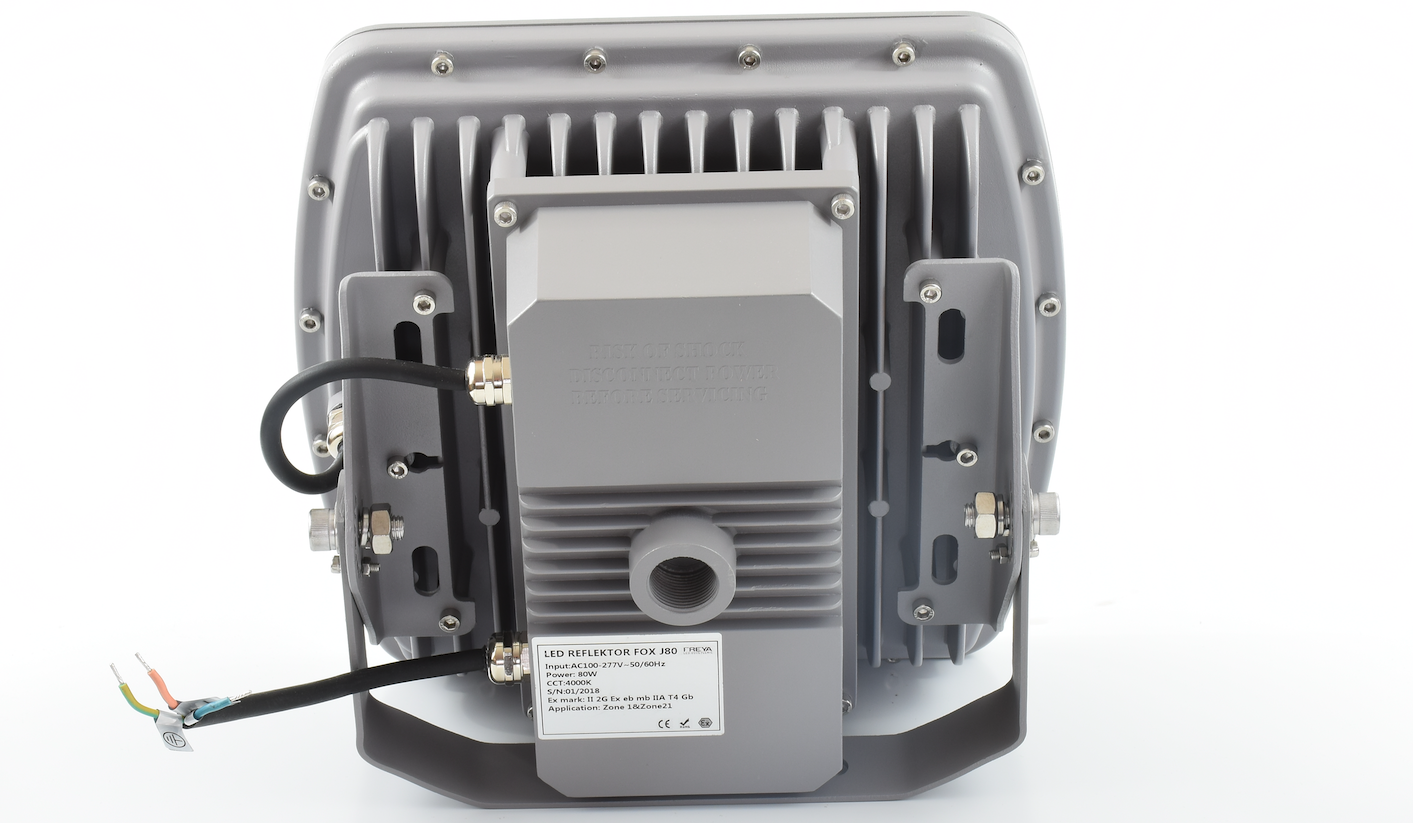
Here is an example of the marking used for FOX LED floodlights:

If you are interested in LED luminaires for explosive atmospheres, get in touch with us.