Artificial light at night fundamentally changes the natural light environment
With the switch to new, efficient lighting technologies, the use of artificial lighting is growing exponentially worldwide. Artificial light at night and the resulting light pollution can, however, cause unwanted physiological effects in the form of suppressed production of melatonin in a wide range of organisms.
Researchers from the IGB (the Leibniz Institute of Freshwater Ecology and Inland Fisheries) analysed data on the effect of light pollution on melatonin production in fish, amphibians, reptiles, birds and mammals (including humans). They found that even low levels of urban skyglow can suppress melatonin production, not only in humans but also in animals.

Indirect light pollution comes from light scattered in the atmosphere and appears as sky brightness (skyglow), which is visible over great distances – 80% of the world’s population and 99% of the population in the United States of America (USA) and Europe live under a light-polluted sky.
Circadian systems exist in almost all living beings. Because light–dark cycles are among the most predictable environmental cues, light is the dominant environmental synchroniser in most organisms. In nature, light comes mainly from extraterrestrial sources such as the sun, the moon or the stars. Artificial light at night alters biological rhythms, with various physiological effects, by interfering with the night sky – in particular melatonin production. In many animals, including humans, night-time production of melatonin is sensitive to light, even at low light levels. In humans and animals, melatonin synchronises the day–night rhythm and influences many other functions – it adjusts the circadian clocks of cells, tissues and organs and regulates processes such as reproduction.
Minimum levels of melatonin suppression
From some 1,900 available studies, the researchers analysed 72 relevant papers that met their criteria relating to light pollution. Based on the data examined, they showed that even very low light levels can suppress melatonin production in some vertebrate species. The figure below shows the relationship between the number of studies identified as relevant and the lowest night-time light levels reported in those studies to suppress melatonin for different groups of vertebrates. In fish the sensitivity threshold is 0.01 lx, in rodents 0.03 lx and in sensitive humans 6 lx. For comparison, the illuminance under a starry sky is 0.001 lx and at full moon it reaches a maximum of 0.3 lx.
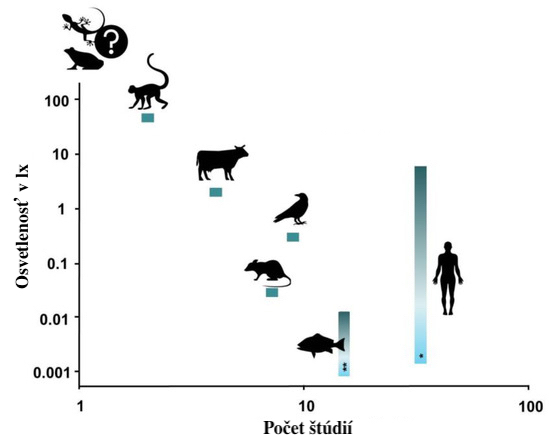
The sensitivity threshold in humans is 6 lux. In urban areas, direct artificial light at night can reach light levels of up to 150 lx.
Melatonin suppression is often accompanied by changes in the behaviour of animals, e.g. the timing of flight activity in birds. Besides affecting melatonin and circadian rhythms, artificial light at night can influence a whole range of activities such as foraging, orientation, predator–prey interactions or the reproduction already mentioned, potentially leading to far-reaching ecological changes.
The low threshold of the circadian rhythm in some species suggests that artificial light at night has the potential to affect wildlife over large areas where light pollution is present. Light levels decrease exponentially with distance from the light source, and mobile species can easily avoid exposure to direct lighting and thus also avoid potentially strong effects on their melatonin rhythms; this may not, however, apply to less mobile species. Vertebrates perceive differences in light level through photoreceptors, such as the retina, and are most sensitive to so-called blue light. The colour temperature of light can have a considerable effect on melatonin suppression, which is particularly sensitive to short wavelengths (400 – 450 nm). Besides intensity and spectral composition, however, the timing and duration of light exposure also affect melatonin suppression.
For example, studies of plasma melatonin in fish under different intensities of artificial light at night show that fish are extremely sensitive to light at night. In many studies, plasma melatonin was reduced even at very low moonlight intensities (0.01 – 1 lx). In freshwater fish species plasma melatonin production was more sensitive to green and red light than to blue light. Conversely, in marine fish species red light had weaker effects than green or blue light at low intensity. These spectral sensitivities correspond to the dominant light colour in the respective environment, as marine fish species are known to have higher retinal spectral sensitivity at shorter wavelengths (blue light) than freshwater fish, whose spectral sensitivity is usually shifted towards longer wavelengths (red light).
Research gaps and recommendations for future research
Based on the data examined, however, the scientists identified several gaps in research to date: “There are no studies on the effects of artificial light at night on melatonin suppression in reptiles and amphibians,” says IGB researcher Dr Franz Hölker, who led the study. The lack of studies on amphibians is surprising given the alarming global decline of some amphibian species and the known ecological and physiological effects of light pollution on other vertebrate species. “Such studies are urgently needed to understand and mitigate the possible impacts of light pollution on these vulnerable groups.”
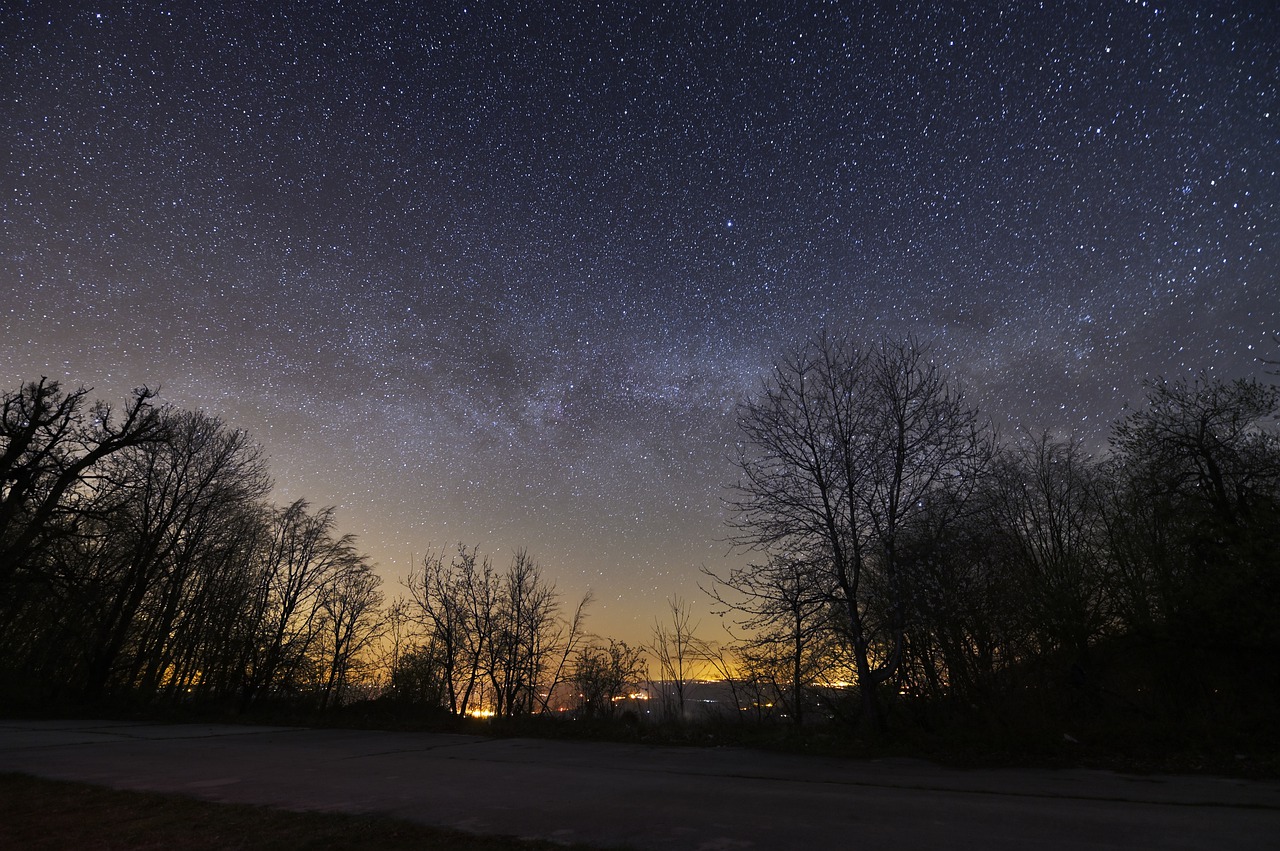
Artificial light at night has significant ecological consequences for flora, fauna and human health. Some catastrophic effects of artificial light at night on certain groups of animals are well known – the deaths of migratory birds and the disorientation of sea turtles hatching from nests on sandy beaches.
Light pollution, unlike other forms of contamination and waste, continues to be overlooked and unregulated in many countries. It is often made worse by excessive, misdirected or intrusive use of lighting. Given the high sensitivity of vertebrates to artificial light at night and the lack of available information, it is essential to research its impact further in order to inform effective strategies for mitigating its effects on the health of humans and vertebrates in natural ecosystems. On an evolutionary scale, light pollution is a new stressor and it is not yet entirely clear how organisms that evolved under stable light–dark cycles are affected by these changes. Several studies have shown that artificial light disrupts ecosystems and could play a significant role in the decline of species whose role in the ecosystem is already weakened by human presence. The scientists agree that all these findings need to be taken into account when drawing up recommendations for the use of lighting at night.
SOURCES:
- https://www.led-professional.com/technologies-research/research-confirms-that-light-pollution-can-suppress-melatonin-production-in-humans-and-animals
- https://www.mdpi.com/2071-1050/11/22/6400/htm
- https://esajournals.onlinelibrary.wiley.com/doi/full/10.1890/1540-9295%282004%29002%5B0191%3AELP%5D2.0.CO%3B2